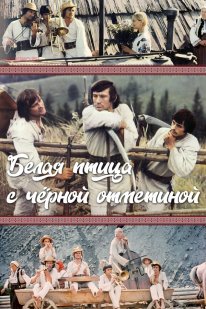
Movie White bird with a black mark (1970)
"The White Bird Marked with Black" (1970) – Illyenko's masterpiece. A profound drama about a family torn apart by war and passion. Powerful performances by Mykolaichuk, Kadochnikova, Stupka.
About the movie White bird with a black mark
Blood and Land: "The White Bird Marked with Black" as a Requiem for Lost Wholeness
"The White Bird Marked with Black" is not just a film; it's a ballad carved into the stone of history, where family blood becomes water washing the shores of schism. Yuriy Illienko, a true visionary of Ukrainian poetic cinema, doesn't merely frame a shot – he constructs a mythological space. His directorial style, recognizable by its metaphorical richness and visual expressiveness, transforms a local drama into an epic parable about destiny.
The film immerses the viewer in Western Ukraine of 1937–1947, where poverty is not a metaphor but a verdict, forcing Oles Zvonar to send his sons into indentured servitude. This is not just an economic decision; it's the initial crack in the family's foundation, triggering a chain reaction. The central challenge is not only external upheavals but also internal disintegration, catalyzed by Dana. This girl, unable to choose between the brothers, involuntarily becomes a mirror for their own unresolved contradictions. Her vacillation amplifies the already fragile balance, transforming brotherly love into burning hatred, which with the onset of war takes on an ideological hue, splitting blood relatives onto opposite sides of the barricades.
In the drama genre, where historical upheavals ricochet through the fates of ordinary people, Illienko's film stands alongside giants like the works of Serhiy Parajanov, sharing with him an aesthetic of imagery and deep symbolism. This is cinema where every moment is imbued not only with plot but also with premonition, where every gesture carries a cultural code.
The acting ensemble, under Illienko's direction, creates not just characters but archetypes whose struggle is a battle of ideas, convictions, and sheer survival:
- Ivan Mykolaichuk: His acting was always the nerve, the embodiment of the people's soul, rebellious and suffering. Here, he likely becomes the heart of the conflict, the center of passion and tragedy, expressing the entire spectrum of human emotions on the brink of survival.
- Larysa Kadochnikova: Her Dana is not merely an object of desire but a fatal beauty, a catalyst whose uncertainty triggers a chain reaction of destruction. Kadochnikova imbues the role with ethereal fragility and an iron will, embodying an image worth both fighting and dying for.
- Kostiantyn Stepankov: A powerful, fundamental figure. His presence on screen is gravity, whether as a father forced to break his children's fates or as one of the brothers bearing the burden of choice and tragic decisions.
- Bohdan Stupka: Even in early roles, Stupka demonstrated profound depth and a capacity for transformation. He embodies an internal struggle that, under the conditions of war, inevitably spills out, taking the form of irreconcilable antagonism, foreshadowing his future status as a legend.
- Vasyl Symchych: An actor whose texture and performance add realism and depth to each character, creating a voluminous image of the era and its people, whether a peasant, a soldier, or a witness to events.
Their interaction is the pulse of the film, its living, bleeding flesh. Illienko, a brilliant cinematographer himself, uses the camera not as a recorder but as an artist, carving expressive frescoes from the canvas of reality. Frame composition, the play of light and shadow, editing – everything is subservient to creating a sense of escalating drama and inevitable fate. Sound, from the whisper of the wind in the Bukovinian forests to the explosions of war, does not merely accompany the action but becomes an independent narrative voice, intensifying the atmosphere of impending disaster and personal tragedy.
"The White Bird Marked with Black" is a cry about fractured identity, about the tragic path of a nation where brothers become enemies, and love turns into a weapon of mutual destruction. The black mark on the white bird is a brand of destiny, a sign of fall, a symbol of the inevitable defilement of the soul in the crucible of history. The film doesn't provide answers; it poses questions – about the price of choice, the fragility of peace, and what happens when human passions collide with the merciless march of an era.
This film is not just a page from a history textbook; it's a living wound, still bleeding, forcing us to reflect on the fragility of human connections and the destructive power of ideologies. It remains a powerful and relevant warning about how easily one can lose oneself and loved ones in the maelstrom of great changes.
Player / Trailer
Leave a comment