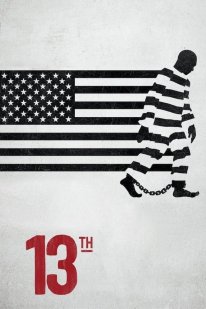
Movie 13th (2016)
An in-depth look at the prison system in the United States and how it reveals the nation's history of racial inequality.
About the movie 13th
A documentary by director Ava DuVernay that became one of the most powerful and widely discussed political statements of the 21st century. 13th is a hard-hitting analysis of systemic racism in the United States, told through the history of criminal justice, mass incarceration, and political manipulation.
The film’s title refers to the 13th Amendment to the U.S. Constitution, which formally abolished slavery but left a critical exception: forced labor is permitted as punishment for a crime. This legal clause becomes the film’s point of departure.
Theme and Concept
13th examines how, after the abolition of slavery, a new form of control over the African American population emerged in the United States — through criminalization, the prison system, and “law and order” policies.
The film traces a clear historical chain: slavery → segregation and Jim Crow → the “war on crime” → the “war on drugs” → mass incarceration as an industry.
This is not an emotional polemic, but a structured, evidence-based analysis, grounded in facts, statistics, archival footage, and expert commentary.
Analytical Approach
Ava DuVernay uses editing as a tool of argument:
-
archival footage is juxtaposed with contemporary images;
-
political speeches are overlaid with statistical data;
-
the visual rhythm emphasizes the repetitive nature of repressive mechanisms.
The film demonstrates how fear has been used as a political resource, and how the image of the “criminal” became a convenient instrument for shaping public opinion.
Special attention is given to the role of:
-
the media,
-
private prisons,
-
corporations,
-
partisan rhetoric.
Expert Voices
The film features historians, lawyers, activists, journalists, and former politicians.
While their perspectives often differ, together they form a multi-layered picture in which the problem is not reduced to a single party or era, but examined as the result of decades of systemic decisions.
Visual and Sound Style
13th employs:
-
minimalist, austere graphic design,
-
sharp, intellectually driven editing,
-
a restrained, tense sound design.
The music never dominates — it reinforces the arguments rather than the emotions. The film deliberately avoids sentimentality, prioritizing clarity and evidentiary force.
Significance and Impact
Following its release, the film became part of the broader public discourse:
-
it is used in universities and schools,
-
frequently cited in political and human rights debates,
-
and is regarded as a key document of the Black Lives Matter era.
13th does not offer easy answers, but forces viewers to confront a central question:
is the justice system an instrument of fairness — or a continuation of historical inequality in a new form?
Editorial Conclusion
13th is not merely a documentary, but an intellectual investigation that dismantles the myth of a “colorblind” legal system.
It demands attention, critical thinking, and a willingness to examine history without comforting illusions.
One of the most important documentary films about power, race, and the structure of modern society.
Player / Trailer
Leave a comment