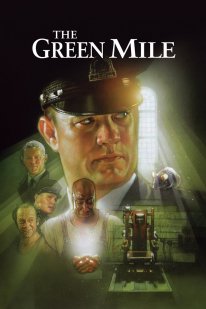
Movie The Green Mile (1999)
Paul Edgecomb runs death row at Cold Mountain prison — until his encounter with the gentle giant John Coffey challenges everything he believes about justice and miracles.
About the movie The Green Mile
“The Green Mile” (1999) is a philosophical drama by Frank Darabont that uses a prison story as a way to reflect on justice, mercy, and the cost of human life. Based on the novel by Stephen King, the film unfolds on death row in an American prison during the Great Depression, where the routine of executions collides with a miracle — quiet, unsettling, and profoundly human.
Concept and Plot
The story is told from the perspective of Paul Edgecomb, the head guard of the death row block known as “Cold Mountain.” His job is to maintain order on the “green mile,” the final path condemned prisoners walk on their way to the electric chair. The arrival of John Coffey, a physically enormous yet childlike inmate, disrupts the established order.
Coffey possesses an inexplicable gift of healing, which exposes the film’s central conflict: what matters more — the letter of the law or the truth seen by the heart?
Expert Review
1) Tone and Direction
Darabont chooses absolute restraint. The camera does not linger on violence or force emotion; key scenes work through pauses, glances, and silence. The film is deliberately slow — a rhythm that makes the viewer experience time alongside the characters, feeling the weight of every decision.
2) Characters and Acting
The ensemble is built without a conventional “main villain”: evil here is systemic. John Coffey is not a messianic figure, but a tragic one, whose compassion makes the cruelty of the world especially unbearable. Paul Edgecomb serves as a mediator between law and conscience; his inner dilemma forms the core of the film.
3) Themes and Meanings
-
capital punishment as a moral trap;
-
mercy versus the institution of punishment;
-
evil as a choice rather than a nature;
-
a miracle that does not save everyone;
-
the responsibility of the witness.
4) Visual Language and Sound
The interiors of death row are intentionally prosaic: dim lighting, green linoleum, the creak of footsteps. The sound design is minimalist, emphasizing the reality of what is happening. Music appears rarely and carefully — not to manipulate emotions, but to mark the moment.
5) Ethical Focus
The film offers no easy answers and does not turn its story into a parable with a “correct” ending. It poses a question that lingers after the credits: if a system is capable of destroying an innocent person, who bears responsibility — the executor or the structure itself?
Cultural Significance
“The Green Mile” has become a rare example of mainstream cinema that does not simplify a complex subject, while remaining accessible and emotionally precise. The film is often used as a starting point for discussions about the death penalty, compassion, and the limits of the law.
Editorial Conclusion
“The Green Mile” is a film about compassion that proves heavier than punishment.
It neither accuses nor оправдывает — it forces us to look and to remember. It is rare cinema where a miracle does not erase tragedy, but only makes it more human.
Player / Trailer
Leave a comment