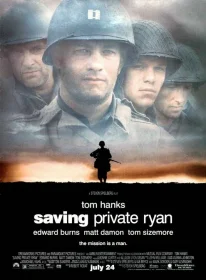
Movie Saving Private Ryan (1998)
Saving Private Ryan (1998) is a landmark war film by Steven Spielberg about the value of human life in war, the realism of combat, and complex moral choices.
About the movie Saving Private Ryan
“Saving Private Ryan” (1998) is one of the most influential war films in cinema history and a landmark work by Steven Spielberg that radically changed the perception of realism on screen. The film became a new reference point for the entire genre, portraying war not as a heroic spectacle, but as chaos, fear, and a burden of profound moral choices.
Plot and concept
After the Allied landing in Normandy, a small squad of American soldiers is ordered to locate and evacuate Private James Ryan, whose brothers have been killed in action. What seems like a simple mission turns into a harrowing journey through a devastated Europe, where every step is paid for with human lives.
The film deliberately contrasts the vast scale of war with the value of a single human life, posing the question: how many lives is it acceptable to sacrifice to save one?
Critical perspective
From the standpoint of cinematic language, “Saving Private Ryan” represents a revolution in war realism.
Spielberg and cinematographer Janusz Kamiński employ:
-
handheld camera work,
-
jagged, fragmented editing,
-
a muted color palette,
-
harsh and “dirty” sound design.
The Omaha Beach landing sequence became a benchmark for battle reconstruction: disorientation, fragmented perception, and a constant sense of vulnerability completely dismantle earlier patriotic pathos.
The film does not romanticize war—it presents it as a space of moral compromise, where heroism often appears as a forced decision rather than a noble feat.
Interesting facts
-
Many World War II veterans recognized the film as the most truthful on-screen depiction of combat.
-
The film won five Academy Awards, including Best Director.
-
Real military locations and extensive historical consultation were used for the Normandy scenes.
-
The film directly influenced subsequent war films and television series.
-
“Ryan” reshaped the visual language of both narrative cinema and war documentaries.
Soundtrack and sound design
The score was composed by John Williams, who deliberately abandoned his usual heroic grandeur. The music is restrained and minimalist, emphasizing grief and loss rather than victory.
Sound design plays a crucial role: muffled hearing after explosions, the whistle of bullets, and the chaotic roar of battle create an almost physical sense of presence, reinforcing the film’s documentary-like authenticity.
Editorial conclusion
“Saving Private Ryan” is not merely a war film, but a moral benchmark for the genre.
It changed the language of cinema, forced the industry to rethink how war is portrayed, and remains a point of comparison for any attempt to depict combat honestly and without embellishment.
Player / Trailer
Leave a comment