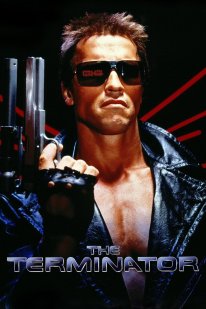
Movie The Terminator (1984)
The Terminator (1984) is a cult sci-fi thriller by James Cameron about AI, fate, and survival. A cold techno-noir classic that reshaped science fiction cinema.
About the movie The Terminator
The Terminator is a film that radically changed the way science fiction was perceived in mainstream cinema. It is not merely a story about a killer robot from the future, but a cold techno-noir nightmare in which fear of machines, fate, and inevitability intertwines with human vulnerability. The film became a starting point for an entire era, turning a low-budget project into a myth of global scale.
Brief Plot Overview (No Spoilers)
In the near future, humanity loses a war against artificial intelligence. The machines decide to change the past in order to win for good. Their target is a woman who does not yet know that the fate of the entire human race depends on her.
In Los Angeles, 1984, the Terminator appears—a ruthless cyborg disguised as a human. It feels no pain, doubt, or emotion. It does not tire. It does not stop.
From the future, a soldier is sent to protect Sarah Connor. His mission is not to win, but to give her a chance to survive. A deadly chase begins, where the technologies of tomorrow collide with the fragile reality of the present, and time itself becomes the ultimate enemy.
Review: Mechanical Horror and Human Drama
The power of The Terminator lies in its sense of inevitability. It is a film that works like a nightmare—slow, echoing, and devoid of relief. Director James Cameron constructs the story as a survival thriller, where science fiction serves not spectacle, but atmosphere.
Arnold Schwarzenegger is perfect precisely because he does not play a “character,” but a function. His Terminator is a walking algorithm: minimal facial expression, mechanical speech, absolute logic. This is not a villain with motivation—it is a catastrophe in human form.
In contrast, Sarah Connor’s arc unfolds. From an ordinary woman unaware of the scale of events, she gradually becomes someone forced to accept a brutal truth: the salvation of humanity begins with the survival of one person. This transformation forms the emotional core of the film.
Equally important is how The Terminator portrays technology—not as a miracle, but as a threat created by humanity itself. The machines are an extension of our own logic, pushed to its extreme.
Screenplay and Authorial Vision
James Cameron did more than direct a film—he created a closed time model in which past and future give birth to one another. The screenplay is built with almost mathematical precision: every detail serves the idea of fate—one that cannot be cheated, only accepted.
The film raises questions that would later become central to science fiction:
-
Can technology escape human control?
-
Does free will exist in a predetermined future?
-
What makes a human human—body or choice?
Interesting Facts
-
The film was made with an extremely limited budget, shaping its harsh, industrial style.
-
Many scenes were shot at night to conceal resource limitations and enhance the noir atmosphere.
-
The Terminator was conceived almost as a horror film, rather than a traditional action movie.
-
The film’s success surprised even its creators and instantly established Cameron as a top-tier director.
Soundtrack: The Sound of a Cold Future
The music by Brad Fiedel is one of the most recognizable electronic soundtracks in film history. Metallic rhythms, synthesizer strikes, and monotonous pulsation create a sense of mechanical fate grinding forward.
The main theme sounds like the march of a machine—neither heroic nor villainous, but impersonal. The music does not accompany the action; it programs the viewer’s anxiety, enforcing a constant sense of threat.
The Film’s Relevance Today
Today, The Terminator feels disturbingly relevant. Artificial intelligence, autonomous systems, decision-making algorithms—what once was fiction is now reality. A film made as a warning increasingly resembles a prophecy, with the central question unchanged:
Who controls technology—the human, or the logic of efficiency?
Editorial Verdict
The Terminator (1984) is not just a cult classic, but a perfectly engineered fear. Cold, dark, and almost hopeless, it is a film where humanity is defended not by strength, but by a stubborn will to live.
This is science fiction that does not comfort—it warns.
Essential viewing for anyone who values cinema where ideas matter more than budget, and atmosphere is stronger than special effects.
Player / Trailer
Leave a comment