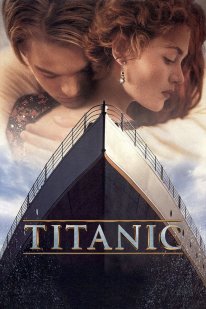
Movie Titanic (1997)
101-year-old Rose DeWitt Bukater tells the story of her life aboard the Titanic, 84 years later. A young Rose boards the ship with her mother and fiancé. Meanwhile, Jack Dawson and Fabrizio De Rossi win third-class tickets aboard the ship.
About the movie Titanic
Titanic (1997) is an epic romantic drama by James Cameron that unites the scale of a historical catastrophe with an intimate human story. The film became a cultural phenomenon of the late 20th century and a benchmark for how mainstream cinema can be simultaneously spectacular, emotionally powerful, and technologically innovative.
Plot and Concept
Set against the backdrop of the legendary liner’s first and final voyage, the film tells the love story of Jack Dawson — a free-spirited artist with no social status — and Rose DeWitt Bukater, a young woman from high society trapped by social expectations.
Their personal drama intertwines with a real historical disaster, where class divisions, the illusion of technological superiority, and human arrogance prove powerless against nature. Titanic speaks not only about love, but also about the fragility of civilization built on confidence in its own infallibility.
Critical Analysis
From a directorial standpoint, the film represents a rare balance between intimate drama and engineering epic. Cameron uses the romantic narrative as an emotional anchor, allowing the audience to experience the catastrophe not abstractly, but through individual lives.
Special attention is paid to detail: the reconstruction of the ship, class hierarchy, and the behavior of crew and passengers at the critical moment. The final act functions as an almost documentary immersion into disaster, where grandiosity gives way to panic, chaos, and tragic silence.
Notable Facts
- The film won 11 Academy Awards, tying the record for the most wins.
- James Cameron personally participated in deep-sea expeditions to the wreck of the Titanic.
- Most of the sets were built at full scale.
- Titanic remained the highest-grossing film in history for many years.
- The film had a major influence on the development of visual effects and historical cinema.
The Soundtrack and Musical Dramaturgy of Titanic (1997)
The music for Titanic was composed by James Horner, creating one of the most recognizable and commercially successful soundtracks in film history. The score became a key emotional element of the film and played a decisive role in its cultural legacy.
James Horner’s Compositional Approach
Horner deliberately abandoned the heroic, march-like sound traditionally associated with disaster films. Instead, he built the score around lyrical themes, slow orchestral phrases, and ethnic motifs that emphasize the story’s intimacy and tragedy.
The main instrumental theme unfolds gradually and appears in multiple variations — from barely perceptible fragments to full orchestral climaxes. The music accompanies not so much the catastrophe itself as human emotion: love, loss, fear, and the acceptance of the inevitable.
Ethnic Elements and Vocals
The soundtrack makes extensive use of Celtic instruments and wordless vocal lines. These elements give the music a sense of timelessness and reference the European roots of the ship’s passengers.
The vocal passages function as an emotional layer rather than narrative text, intensifying scenes of farewell and tragic realization.
The Role of Celine Dion and “My Heart Will Go On”
The central element of the soundtrack is the song “My Heart Will Go On”, performed by Celine Dion.
The music was composed by James Horner, with lyrics by Will Jennings. The song was originally conceived as a vocal version of the film’s main musical theme.
The track plays over the end credits and is not used as a full vocal number within the film’s narrative. However, its melody is woven throughout the movie in instrumental variations, preparing the emotional impact of the finale.
Despite the director’s initial doubts about including a pop ballad, the song was approved and became an inseparable part of the film.
“My Heart Will Go On” received:
- an Academy Award for Best Original Song;
- a Grammy Award;
- status as one of the best-selling singles of all time.
Sound Design and Musical Restraint
Music in Titanic is used selectively. During disaster scenes, Horner often pushes the score into the background or removes it entirely, leaving the audience alone with realistic sound design: the groan of metal, rushing water, screams, and abrupt moments of silence.
This approach strengthens the documentary-like realism of the events and underscores the scale of the tragedy without excessive emotional manipulation.
The Significance of the Soundtrack
The Titanic soundtrack became an example of how music can:
- shape a film’s emotional memory;
- exist as an independent artistic work;
- enhance drama without overpowering the image;
- become part of popular culture beyond the film itself.
James Horner’s score and Celine Dion’s performance turned the soundtrack into one of the film’s defining symbols, as recognizable as its visual imagery.
Editorial Conclusion
Titanic is a film about human emotion set against the indifference of history.
It remains relevant not because of the scale of the disaster, but because of its ability to unite personal drama with a global event, reminding us that behind every historical narrative stand real human lives.
Player / Trailer
Leave a comment