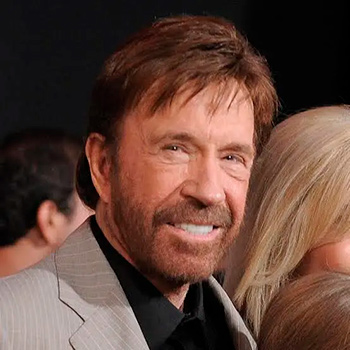
Full Name: Carlos Ray Norris
Date of Birth: March 10, 1940
Place of Birth: Ryan, Oklahoma, USA
Professions: actor, martial artist, producer, writer
Styles: karate (Tang Soo Do), Brazilian jiu-jitsu
Status: a cult figure of American cinema and one of the symbols of 1980s–1990s action films
Introduction: from a real fighter to a cultural phenomenon
Chuck Norris is a rare example of an artist whose popularity did not grow out of cinema, but from real achievements in martial arts. His journey is a transformation from a karate champion into a pop culture icon whose name has become synonymous with strength, discipline, and invincibility.
Early years and military service
Carlos Ray Norris was born into a poor family and spent his childhood in unstable conditions. His father struggled with alcoholism, which influenced the character formation of the future actor.
After graduating from high school, Norris enlisted in the United States Air Force and was stationed in South Korea. It was there that he first encountered martial arts, beginning to study Tang Soo Do — a Korean style that later became the foundation of his career.
Martial arts career: the path of a champion
After returning to the United States, Norris devoted himself entirely to training and competition. In the 1960s, he became one of the leading figures in karate:
- multiple-time karate tournament champion
- World Middleweight Champion (1968–1974)
- founder of his own martial arts school
He developed his own system, Chun Kuk Do, combining elements from different styles.
Among his students were celebrities, including <:contentReference[oaicite:0]{index=0}>, who played a key role in Norris’s transition into film.
Transition to cinema and collaboration with Bruce Lee
His first major success in film came after his appearance in
Way of the Dragon, where Norris starred alongside <:contentReference[oaicite:1]{index=1}>.
Their fight in the Colosseum became one of the most iconic scenes in the history of martial arts cinema and brought Norris to the international stage.
Career peak: action star of the 1980s
In the 1980s, Chuck Norris became one of the leading faces of American action cinema. His films were characterized by straightforward plots, an emphasis on physical strength, and moral clarity.
Key works:
- Missing in Action
- Delta Force
- Invasion U.S.A.
His screen image — a lone hero fighting for justice — became a reflection of the spirit of the Cold War era.
Television success: Walker, Texas Ranger
A new stage of popularity began with the series
Walker, Texas Ranger (1993–2001).
The project combined:
- martial arts
- crime storytelling
- moral and ethical themes
The series became one of the most recognizable TV shows of its time and reinforced Norris’s status as a cultural symbol.
Philosophy, books, and public activity
Beyond cinema, Chuck Norris is actively involved in:
- writing books (including autobiographies and motivational literature)
- promoting sports and martial arts
- charitable and educational programs for youth
His philosophy is built on discipline, faith, self-development, and responsibility.
Internet phenomenon: “Chuck Norris Facts”
In the 2000s, Chuck Norris became a figure of internet culture thanks to memes known as “Chuck Norris Facts”.
These hyperbolic jokes transformed his image into:
- a symbol of superhuman strength
- an ironic legend of pop culture
Unlike many actors, Norris embraced this phenomenon with humor, which only increased his popularity among a new generation.
Influence and legacy
Chuck Norris is not just an actor, but a bridge between real sport and the film industry. His contribution can be viewed across several dimensions:
- popularization of martial arts in the United States
- shaping the “lone hero” archetype
- influence on the development of the action genre
- transition into a cultural symbol and meme icon
In March 2026, Chuck Norris was hospitalized in Hawaii after his health condition worsened. He passed away on March 19, 2026, at the age of 86, nine days after his birthday. His family announced his death the following day.
The passing of Chuck Norris became a significant event for the global entertainment and martial arts industries. He left behind a multifaceted legacy that combines real sporting authority, a successful acting career, and cultural influence that extends far beyond cinema.
Norris was one of the first to bring authentic combat techniques into mainstream film, shaping the archetype of the “invincible hero,” which influenced subsequent generations of actors and the action genre as a whole. His contribution to the popularization of karate and other martial arts in the United States and worldwide remains fundamental.
In addition to cinema, he was actively involved in public and educational activities, supporting youth programs and promoting the values of discipline, self-control, and personal responsibility.
In popular culture, Chuck Norris became a unique phenomenon: internet memes and the so-called “Chuck Norris Facts” turned his image into a symbol of superhuman strength and ironic invincibility. This is a rare case where an actor managed to remain relevant across multiple generations — from the era of classic action films to the digital age.
Today, the name of Chuck Norris remains not just a part of film history, but an independent cultural symbol — an image of strength, principles, and personal resilience that continues to live in the collective consciousness.
Conclusion
Chuck Norris is one of the few figures whose biography spans several eras: from classical martial arts to digital culture. His journey is a story of how discipline and personal strength can evolve into a global phenomenon that extends far beyond cinema.