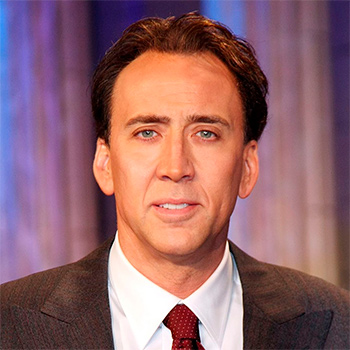
Nicolas Cage is an American actor, producer, and one of the most paradoxical figures in the history of modern cinema. His career is a rare example of absolute freedom within the Hollywood system: from auteur arthouse and Oscar-winning drama to blockbusters, B-movie genre films, and radical acting experiments. Cage is an artist who consistently defied expectations and proved that individuality can matter more than reputational “safety.”
Origins and early years
Nicolas Cage was born on January 7, 1964, in Long Beach, California. His real name is Nicolas Kim Coppola; he is the nephew of director Francis Ford Coppola. Crucially, Cage deliberately rejected his famous surname, seeking to build a career without relying on family connections or the industry’s expectations.
The stage name “Cage” was chosen deliberately. It refers to two sources at once: the comic-book character Luke Cage and the avant-garde composer John Cage. This combination precisely reflects the actor’s nature—pop culture elevated into experiment. His love for comic books was never superficial: Cage has always openly spoken about his fandom for superhero mythology and even named his son Kal-El, after Superman’s real name. This detail underscores not eccentricity, but Cage’s deep connection to cultural archetypes and the myths of mass art.
Early roles and the search for a personal language
Beginning his career in the early 1980s, Cage quickly established himself as an actor who did not strive for everyday realism. Even in his early roles, he gravitated toward expression, grotesque elements, and inner rupture. His performances often went beyond conventional “believability,” yet remained emotionally honest.
It was already clear then: Cage was not interested in neutral images. He sought extreme states, inner conflict, and tension between external form and emotion. This made him uncomfortable—but unmistakably visible.
Breakthrough and recognition
A true turning point came with the drama Leaving Las Vegas. Cage portrayed a man consciously moving toward self-destruction with frightening openness and no protective barrier between actor and character. The role earned him an Academy Award and secured his status as a serious dramatic performer.
Notably, after this success Cage did not choose the path of prestigious, “safe” roles. On the contrary, he deliberately began mixing major studio projects with auteur and genre experiments, rejecting a linear career trajectory.
Key films
-
Raising Arizona (1987) — an early cult role and absurdist comedy
-
Leaving Las Vegas (1995) — the Oscar-winning dramatic performance
-
The Rock (1996) — a transition into large-scale Hollywood action
-
Con Air (1997) — establishing his status as a 1990s action star
-
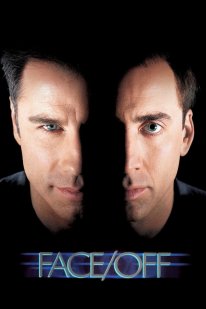
Face/Off (1997) — a play with dual identity
-
Adaptation (2002) — virtuoso transformation and meta-acting
-
Ghost Rider (2007) — comic-book mythology in its pure form
-
Mandy (2018) — a return to radical auteur cinema
-
Longlegs (2024) — one of the most disturbing performances of his career, marked by near-total dissolution into the character
Action stardom, crisis, and professional honesty
In the second half of the 1990s, Cage became one of Hollywood’s leading action stars. However, in the 2000s his career entered a period of extreme unevenness. The reasons were not only creative but also financial: the actor faced serious tax debts amounting to millions of dollars.
This fact explains Cage’s participation in a large number of forgettable projects. Yet what matters more is something else: even in the weakest films, he never worked at half strength. Cage did not treat roles as a formal “contract obligation”—he continued to give his all, experiment, and search for acting truth even where the film itself failed to meet expectations. This rare display of professional ethics eventually earned him not ridicule, but respect.
Memes, cult status, and internet mythology
Cage’s expressive acting style made him one of the first actors to become a full-fledged internet phenomenon. Frames such as the famous “You don’t say?” moment from Vampire’s Kiss became memes long before the TikTok era, cementing his reputation as the “king of memes.”
Importantly, meme culture did not destroy his career; it became part of a new cultural layer. Cage emerged as an actor who is both ironicized and taken seriously at the same time—a rare combination in the digital age.
Later period and renewed recognition
In the 2010s–2020s, Cage underwent yet another reappraisal. His roles in auteur and genre projects once again attracted the attention of critics and audiences. The film Longlegs became the culmination of this stage: Cage portrayed a serial killer by completely altering his appearance, voice, and physicality—almost disappearing behind the role.
This film solidified his status not as a “returned star,” but as an actor willing to go all the way at any age.
Acting method: “new shamanism”
Cage himself describes his approach as “new shamanism”—a synthesis of silent cinema, expressionism, classical training, and intuitive impulse. What interests him is not external plausibility, but emotional truth, even if it appears excessive or unsettling.
Editorial opinion
Nicolas Cage is an actor whose career defies linear description. He consciously chose risk, accepted the consequences of his decisions, and turned crises into part of an artistic myth. His path proves that freedom without compromise is possible in cinema—if it is backed by genuine passion for the craft.
Cage is an artist who allowed himself to be strange, vulnerable, and excessive at a time when the industry demanded predictability. He did not hide mistakes, did not shield himself behind an image, and was not afraid to look ridiculous. That is why today Nicolas Cage is not just an actor, but a cultural phenomenon where arthouse, pop culture, memes, and true acting obsession converge.
 HDIMDb 7.3KP 7.8